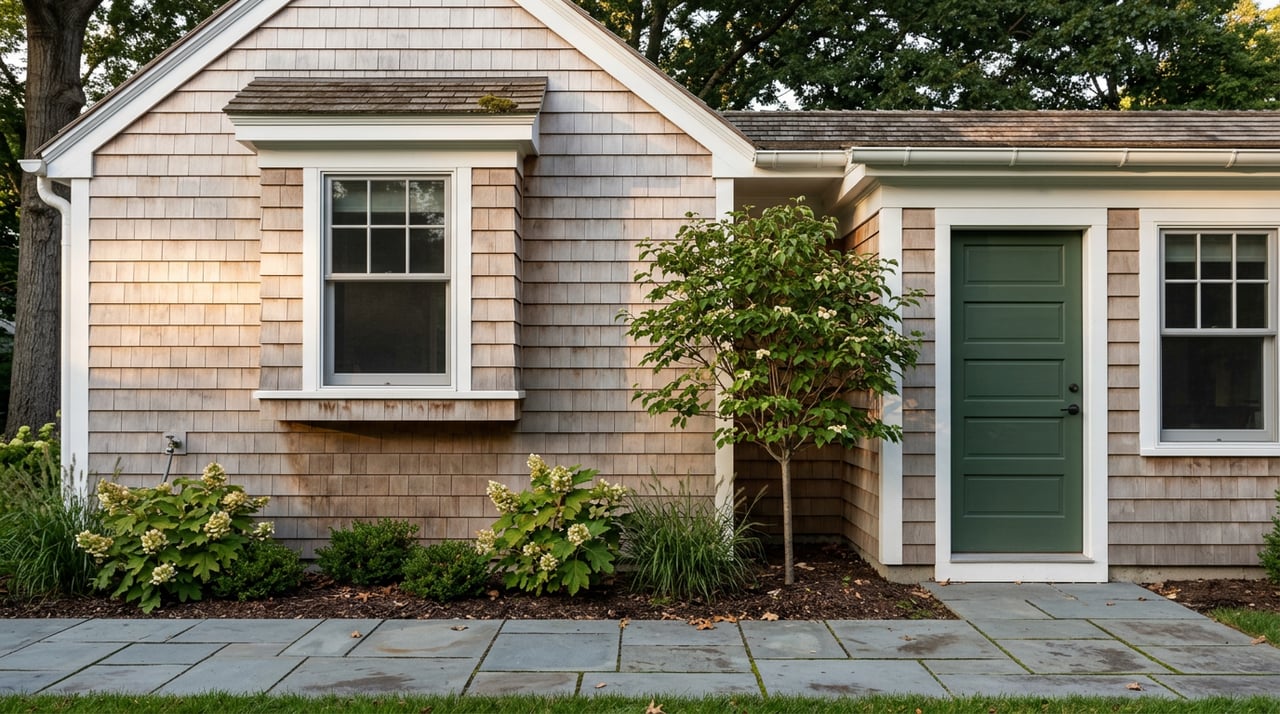
Can you put vinyl siding on a house in Bellport Village? The honest answer is that it depends on which side of a boundary you're standing on, and that boundary doesn't show up in a listing photo, a price per square foot, or a walk down South Country Road. It shows up months later, when a homeowner applies for a permit and finds out which set of rules their address falls under.
This year's village meeting records make the split easy to see. In a June 2026 Bellport Village Architectural Review Board filing, a homeowner on Station Road got approval for white board and batten paired with light gray vinyl siding, gray asphalt shingles, and white aluminum trim. In a March 2026 Historic District Preservation Commission filing on Academy Lane, a renovation that enclosed a breezeway and added a dormer was approved only with yellow cedar shingle siding, red cedar shingle roofing, white Azek trim, and forest green wood shutters, because that property falls under Historic District Preservation Commission review. Same village, same year, two completely different material lists.
Two boards, two rulebooks
Bellport Village runs two separate review processes for exterior work, and which one applies to your house depends on a line most buyers never think to ask about.
That's how vinyl siding shows up in an ARB approval on Station Road while a Station Road Architectural Review Board filing records approval of a Hardie Plank facade a few doors down. The board has range.
The village's historical information page says the Historic District Preservation Commission oversees six designated historic districts and three individually landmarked houses. Vinyl never appears in a single one of the historic district applications reviewed for this piece.
That difference isn't cosmetic. It changes your renovation budget and your timeline before you've hired a single contractor.
What the case files actually show
Pulling from this year's public hearing notices gives a clearer picture than any general description of "strict historic guidelines." A few examples from 2026:
- On Academy Lane, a two-story dwelling with an attached garage was approved to enclose a breezeway, add a second-story dormer, build a covered front porch, and convert part of the garage to pool storage, with yellow cedar shingle siding, red cedar shingle roofing, white Azek trim, and forest green wood shutters, all under Historic District Preservation Commission review.
- A Historic District Preservation Commission filing for a Browns Lane application to convert a covered side porch to habitable space and build a rear second-story addition records approval on the condition that siding, roofing, trim, and windows all match the existing dwelling, since the property sits in the Browns Lane Historic District.
- A Historic District Preservation Commission filing for a Bellport Lane in-ground swimming pool records that it still had to go through the commission, because the lot falls inside the Bellport Lane Historic District, even though a pool doesn't touch the house's exterior materials at all.
- Outside any historic district, a Station Road property was approved for a rear addition using white Hardie Plank siding, charcoal gray asphalt shingles, and white Azek trim, under the standard Architectural Review Board.
- Also outside a historic district, an Architectural Review Board filing records approval of a Leisurely Lane project to demolish and rebuild an attached garage and breezeway, plus a rear addition and deck, with red cedar shingle siding and Azek trim
The part that costs time, not just money
Money isn't the only thing that changes when a house sits in a historic district. Time does too, and this is where sellers and buyers both get caught flat.
Under the village's historic preservation code, no building permit can be issued for exterior work on a landmark or historic district property until the Historic District Preservation Commission has first issued a Certificate of Appropriateness. The commission has up to 60 days from the close of a public hearing to render that decision. A chairman can grant an expedited review for minor work that clearly meets the district's guidelines, but that's discretionary, not guaranteed. As of April 2026, JA Spector's permit-tracking guide, citing the Village Building Department, put typical building permit processing in the village at two to four weeks once a complete application is filed.
Here's the comparison as it plays out in practice:
| Historic District / Landmark | "A" or "B" Residence District, non-historic | |
|---|---|---|
| Reviewing board | Historic District Preservation Commission | Architectural Review Board |
| Vinyl siding | Not seen in any 2026 filing reviewed | Approved in at least one 2026 filing |
| Decision timeline | Up to 60 days after hearing closes | Permit typically 2 to 4 weeks once filed |
| Permit issued before approval | No, COA required first | Standard permit process applies |
If you're a seller planning to re-side or add square footage before listing a historic district home, that 60-day clock is a real scheduling constraint, not a formality. If you're a buyer comparing two houses that look similar in photos, the one inside a historic district may take longer and cost more to modify, even if the asking price is identical.
Why this matters beyond renovation
The village layers on one more compliance detail worth knowing if you're eyeing a Bellport Village property as an income unit. The village's Building Department recently introduced a rental license requirement, meaning any owner who wants to rent out a home has to apply for a license and pass a safety inspection before a tenant moves in. For short-term summer rentals specifically, the village also requires the property to present a fully executed lease so the renter can obtain a Seasonal Guest ID Card for stays running from Memorial Day weekend through Labor Day. None of that is unique to historic district homes, but it's another example of the same lesson: in Bellport Village, what a property can become is governed by more than its listing description.
None of this means a historic district home is a worse buy. Some of the most requested addresses in the village, on Bellport Lane and Browns Lane among them, sit inside these districts, and the commission still approved a second-story addition and a new in-ground pool on properties in those two districts in 2026. It means the timeline and the materials list are part of the deal, not an afterthought you discover during a renovation quote.
FAQ
How do I know if a specific Bellport Village address is in a historic district? The village's Historic District Preservation Commission oversees six historic districts and three individually landmarked houses, and recent hearing notices name specific districts, including Browns Lane and Bellport Lane. A property's public hearing history, when one exists, will state the applicable district directly.
Does a historic district designation mean I can't add square footage? No. Commission filings in 2026 approved a second-story addition, a dormer, an enclosed breezeway, and a new in-ground pool inside historic districts.
Can I skip the Certificate of Appropriateness if the work is minor? Possibly. The code allows the commission chairman to grant expedited review for work that clearly meets the district's adopted guidelines and won't affect a historic feature, but that decision is at the chairman's discretion, not automatic.
If you're weighing a Bellport Village purchase and want to understand what a specific address can and can't become, that's exactly the kind of groundwork Keith Dawson and the Dawson Realty Team walk through before you write an offer. Get a Free Home Valuation and let's talk through what your renovation runway actually looks like.
This article is general information, not legal, tax or financial advice. Consult a qualified professional about your situation.