Type "Brookhaven home prices" into a search bar and you will get an answer within seconds. That is the problem. The answer will be confident, specific, and very possibly describing a market you have never set foot in, because at least three different places currently answer to the name Brookhaven, and only one of them is the historic Long Island hamlet on the Carmans River that most Suffolk County buyers mean when they type it.
Even after you narrow the search to the right coast, the right county, and the right zip code, the numbers still will not agree with each other. Not by a little. In the same stretch of 2026, one major listing site put the hamlet's median sale price at $695,000. Another view from that same site put it at $749,551. A third site put the median asking price at $1.14 million. A fourth site displayed two different price figures on the same page. None of these sources is wrong exactly. They are all measuring something real. They are just not measuring the same thing, in the same window, off the same handful of sales.
One Name, Three Markets
Start with the collision that causes half the confusion before pricing even enters the picture. The Town of Brookhaven is the largest town in Suffolk County, and its own government site lists more than fifty hamlets and villages inside its borders, including Bellport, Blue Point, Holbrook, Miller Place, Mount Sinai, East Patchogue, Patchogue, and Port Jefferson. If you are comparing neighborhoods across our own coverage area on Long Island, you are almost certainly comparing different corners of this same town, whether or not the word "Brookhaven" ever appears in the listing.
Inside that sprawling town sits a specific, much smaller hamlet that is also just called Brookhaven, zip code 11719. It has its own identity, its own historic district, and a population that runs to roughly 3,600 people. It was named for the township back in 1879, and the overlap has caused confusion for locals ever since.
Then there is a third Brookhaven that has nothing to do with any of this: a suburb of Atlanta, Georgia, with its own Peachtree corridor real estate market, its own median values, and its own local blog content optimized for the same search terms. National data aggregators do not always sort this out cleanly. A buyer researching "Brookhaven" from outside the region can land on pricing that describes a completely different state.
The Wedge of Land the Numbers Are Actually Describing
Before the pricing question, it helps to know what the hamlet actually is, because the boundary matters more than most listings let on. Longtime residents describe Brookhaven hamlet as a wedge of land bounded by the Great South Bay, the Carmans River, Old Stump Road, and South Country Road, cut roughly in half by Beaver Dam Road running from Squassux Landing west to South Country Road. It is not a village. It has no incorporated government of its own. It is woods, marsh, open field, and widely spaced houses, the kind of place that the Post-Morrow Foundation says a committee of residents petitioned the Town of Brookhaven to protect as a historic district in 1984, the largest such district in the town, with support from an essay written by hamlet resident and philosopher Arthur Danto making the case for its preservation.
That petition succeeded, and it matters for anyone shopping here today. It is also the reason the hamlet still looks the way it does: working farms, old cemeteries, a marina at the end of a country road, instead of subdivided cul-de-sacs.
Different Sites, Different Price Measures in 2026
Now the pricing itself, and this is where the story gets useful for anyone actually trying to price a home here.
Looking at trailing three-month data through June 2026, one major site puts the hamlet's median sale price at $695,000, up a modest 0.7 percent year over year, with homes taking 78 days to sell compared to 53 days the year before. That same site, in a separate single-month snapshot for May 2026, shows a median of $749,551, up 7.5 percent year over year. Two views from the same source, with overlapping but different reporting windows, show a roughly $55,000 gap and different growth rates.
Pull up a different site's March 2026 figures and the median asking price jumps to $1.14 million, with days on market falling 24 percent from the year before. That is not a modest disagreement. That is one source describing a market accelerating while another describes it cooling, in roughly the same season.
Check a third site and you find two numbers on a single page: $829,000 used in its own affordability calculator, and $749,000 quoted as the median sale price with 9 percent year-over-year growth, a few lines below. The same page presents both figures.
None of these numbers is fraudulent. Each one is a snapshot of a market too small to hold a median still.
How a Small Number of Sales Can Move the Median
Here is the mechanism behind all of it. Redfin's own June 2026 count for the hamlet shows four home sales that month, down from five the year before. A median calculated from four or five transactions is not a market indicator in the way a median calculated from four hundred transactions would be. It is closer to a snapshot of whichever specific houses happened to close.
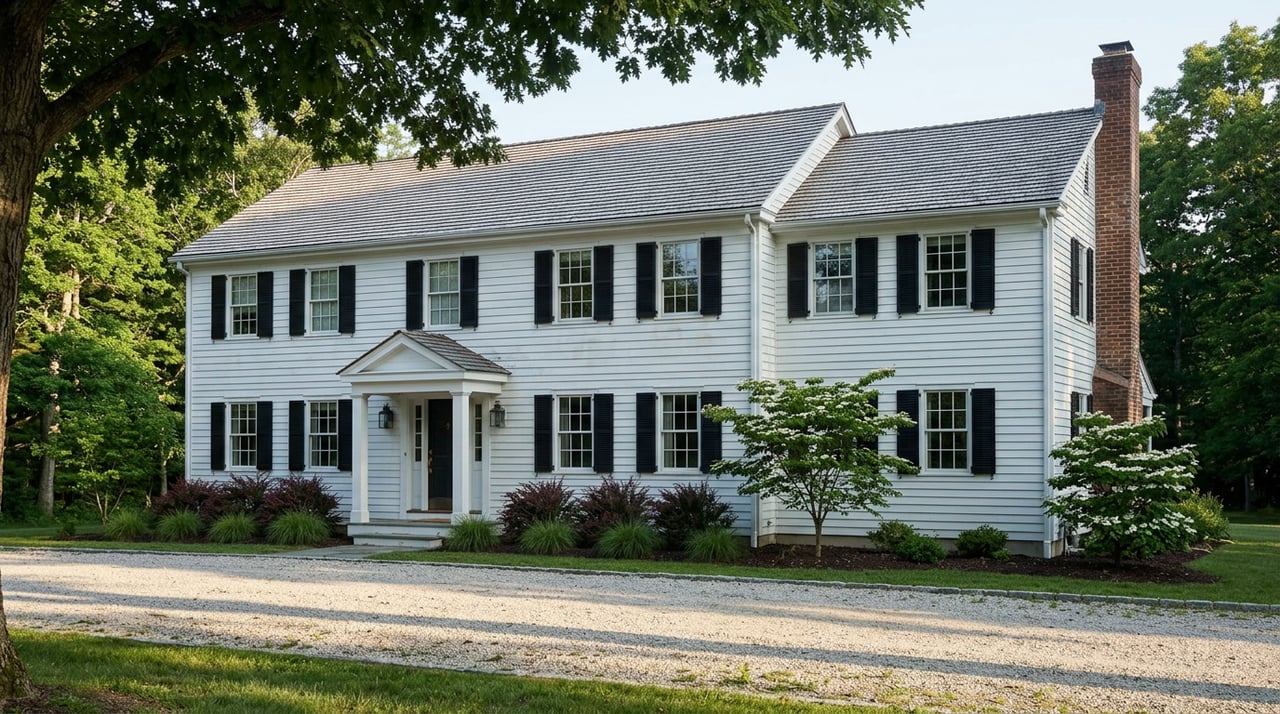
If one of those four sales is a renovated colonial on a landscaped acre near South Country Road that closes at $1.35 million, and another is a wooded parcel with a modest ranch that closes at $625,000, the "median" for that month depends on how all the sales rank by price. Change one closing, and the headline number moves by tens of thousands of dollars, sometimes more. That is not the hamlet's housing market shifting. That is arithmetic responding to a small sample.
This is why the direction of the market looks different depending on which weeks you catch it in. A single luxury waterfront closing can make the trailing quarter look like it accelerated. A single land sale can make the same quarter look like it stalled. Both readings can be technically accurate and both can be misleading if you treat either one as a forecast.
What This Means If You Are Comparing Brookhaven to Somewhere Else
If you are weighing Brookhaven hamlet against Bellport Village, Mount Sinai, Miller Place, or any other corner of the town, the practical lesson is not to throw out the published medians. It is to stop treating any single monthly median from a market this size as the market. Ask instead what specific comparable homes on specific streets, ideally within the same section of the hamlet such as the East Canal area or the Beaver Dam Road corridor, have closed for over the last six to twelve months. That is a slower question to answer than a portal search box, and it is the only version of the answer that will hold up when you are the one signing a contract.
It is also worth remembering what a median cannot show you: a $600,000 hi-ranch a short walk from Squassux Landing and a $1.5 million architect-updated colonial on several wooded acres can both be genuine Brookhaven hamlet homes closing in the same quarter, at prices that have almost nothing to do with each other beyond sharing a zip code.
The Landmarks a Sold Sheet Will Never Show You
None of the pricing noise changes what actually draws people to this hamlet in the first place. Squassux Landing still sits at the end of Beaver Dam Road as a working marina and a place to watch the marshlife. The Post-Morrow Foundation, established in 1969, has preserved roughly 100 acres along Beaver Dam Creek, with public trails and an ongoing wetlands restoration effort run with the U.S. Fish and Wildlife Service. Down the same road, the HOG Farm has been growing produce on hamlet land since 1996, now across 20 acres, with a farm stand that runs Saturday mornings and a CSA that supplies a growing list of Long Island restaurants. These are the details that do not show up in a median sale price and are usually the reason a buyer stops comparing numbers and starts imagining a life there.
Frequently Asked Questions
Is Brookhaven hamlet the same as the Town of Brookhaven? No. The Town of Brookhaven is a much larger municipal government that includes more than fifty hamlets and villages, several of which we cover individually, including Bellport, Mount Sinai, Miller Place, Holbrook, and East Patchogue. Brookhaven hamlet, zip code 11719, is one specific, much smaller community inside that town.
Why do real estate websites show such different prices for the same address range? Mostly sample size. With only a handful of homes selling in the hamlet each month, one high-end colonial or one land sale can swing a median by tens of thousands of dollars, and different sites also use different measures such as sale price versus asking price, or a single month versus a trailing quarter.
Does the historic district affect what I can renovate? It can. Brookhaven hamlet's historic district, established after a 1984 petition, was created specifically to protect the rural character residents petitioned to preserve
A market this small does not reward guessing at a headline number. It rewards knowing the actual streets, the actual recent closings, and the actual condition of the specific house in front of you. If you are trying to make sense of what a home in Brookhaven hamlet, or anywhere else in this stretch of Suffolk County, is really worth right now, Keith Dawson and the Dawson Realty Team can walk you through the real comparables behind the noise. Get a Free Home Valuation and start with numbers built for your address, not for a search engine.
This article is general information, not legal, tax or financial advice. Consult a qualified professional about your situation.